5 Key Elements of a Scalable Agri Field Service Delivery Network
Tech-Enabled Agriculture Needs Strong Execution
Agriculture operates in real time. Crop cycles don't pause for planning cycles. Weather and pest pressures demand immediate, on-ground response.
This is why a well-structured field service delivery network is not a nice-to-have — it is the foundation on which everything else is built. Without it, even the most sophisticated advisory tools and drone technologies fail to reach the farmer at the right moment.
In a country like India, where landholdings are small and scattered across diverse agro-climatic zones, last-mile execution determines whether innovation creates impact or simply exists on a slide deck. Organisations serious about sustainable scale need systems designed to reach thousands of villages without losing quality or consistency.
Salam Kisan, part of the PRYM Group and in partnership with Mavis and SkyMul, has built in-house drone capabilities that connect manufacturing, training, compliance, and structured service delivery into a single operating system — designed specifically to work at scale across Maharashtra and beyond.
What "Scalable" Actually Means in Agriculture
Scalability in agriculture is not about expanding to more districts. It is about maintaining the same quality of service across regions, crops, and seasons — without a proportional rise in cost or operational chaos.
A truly scalable network delivers consistent outcomes whether it is operating in ten villages or ten thousand. The service experience a farmer receives in one cluster should not differ meaningfully from what a farmer in another cluster experiences. Unit economics should improve as the network grows, not worsen. And critically, the system should be able to absorb growing demand without breaking down.
Real scalability is built before it is needed. When you add clusters, service hubs, pilots, and advisors, the system should handle that growth — not struggle to contain it...
FAO provides research-based material on extension systems, scalable advisory models, and digital infrastructure that supports predictable expansion. It is neutral, institutional, and widely cited in policy and development work.
Element 1 – Strong Last-Mile Presence
Agriculture is deeply local. Soil quality changes across small distances. Crop cycles follow micro-climatic patterns. And a farmer's willingness to adopt new services is often shaped by trust in the person standing in front of them, not an app or a call centre.
This is why a scalable agri field service network must start at the village level. It requires rural advisors embedded in communities, cluster coordinators who know the land and the farmers, and service hubs close enough to respond quickly when needed.
When farmers know exactly who to contact and their requests are met consistently, trust builds naturally. And trust is what drives adoption. Local credibility is not a soft benefit — it is the structural foundation that makes everything else work.
Element 2 – Standard Operating Procedures (SOPs) for Every Service
Expanding without standardisation does not produce scale. It produces variability — and in agriculture, variability in service delivery leads directly to variability in results for the farmer.
Every service offered through the network should follow a clearly documented Standard Operating Procedure. This means defined steps for pre-service inspection and equipment calibration, a fixed safety protocol before any drone flight, and a structured post-service reporting process that does not rely on memory or improvisation.
When SOPs are documented and followed, new team members can be onboarded faster. Service quality becomes consistent across clusters. Errors reduce significantly. Compliance becomes manageable rather than reactive.
Standardisation is not bureaucracy — it is what allows a network to grow without losing its integrity.
Element 3 – Technology for Scheduling, Tracking, and Reporting
Manual coordination works at small scale. Beyond a few dozen service touchpoints, it becomes slow, error-prone, and impossible to monitor.
A scalable field service operation requires a digital backbone: one that handles booking and scheduling, assigns pilots to jobs, optimises routes across a cluster, and tracks service completion in real time. Field teams need to be able to log activities digitally — quickly and simply. Managers need visibility into acreage covered, job completion rates, and asset utilisation without waiting for end-of-day calls.
The key design principle here is usability. Technology that adds steps to a field operator's day will be worked around, not adopted. Technology that makes their work easier will be used consistently — and that consistency is what creates accountability and better decisions at every level.
Element 4 – A Continuous Training System
Every agricultural service — including drone spraying — ultimately depends on the skill, discipline, and awareness of the person delivering it. Technology cannot compensate for an undertrained operator.
A scalable model must include structured training pathways: certification programmes for drone pilots, safety and compliance training aligned to DGCA requirements, hands-on field practice, and regular refresher courses as regulations evolve and new services are added.
The critical point is that training cannot be treated as a one-time onboarding event. It must be continuous. Teams need to adapt as the service portfolio grows, as new crops and geographies are added, and as standards are updated.
An investment in a strong training engine is an investment in the quality of every service delivered — at any scale.
Element 5 – Data-Driven Decision Making
Every field activity generates data: the crop stage at the time of service, the area covered, the spray volume used, the pest pressure observed, and whether the farmer booked a repeat visit. Taken individually, these are records. Captured systematically across clusters, they become strategic intelligence.
Patterns begin to emerge. Certain regions show seasonal spikes in pest pressure. Some crops require more frequent service interventions than others. Operator productivity varies in ways that can be addressed with targeted training. Research in precision agriculture indicates that data-led interventions can reduce repeat spray requirements by up to 40% in affected crops.
This kind of field intelligence shifts decision-making from reactive firefighting to proactive planning. It also makes service recommendations more credible — because they are backed by observed outcomes from the field, not generic guidance.
In a network designed for scale, data is not a reporting function. It is an operational asset.
Element 6 – Drone Integration for Fast and Scalable Farm Services
When drone services are embedded within a structured field service network, they significantly amplify what that network can deliver.
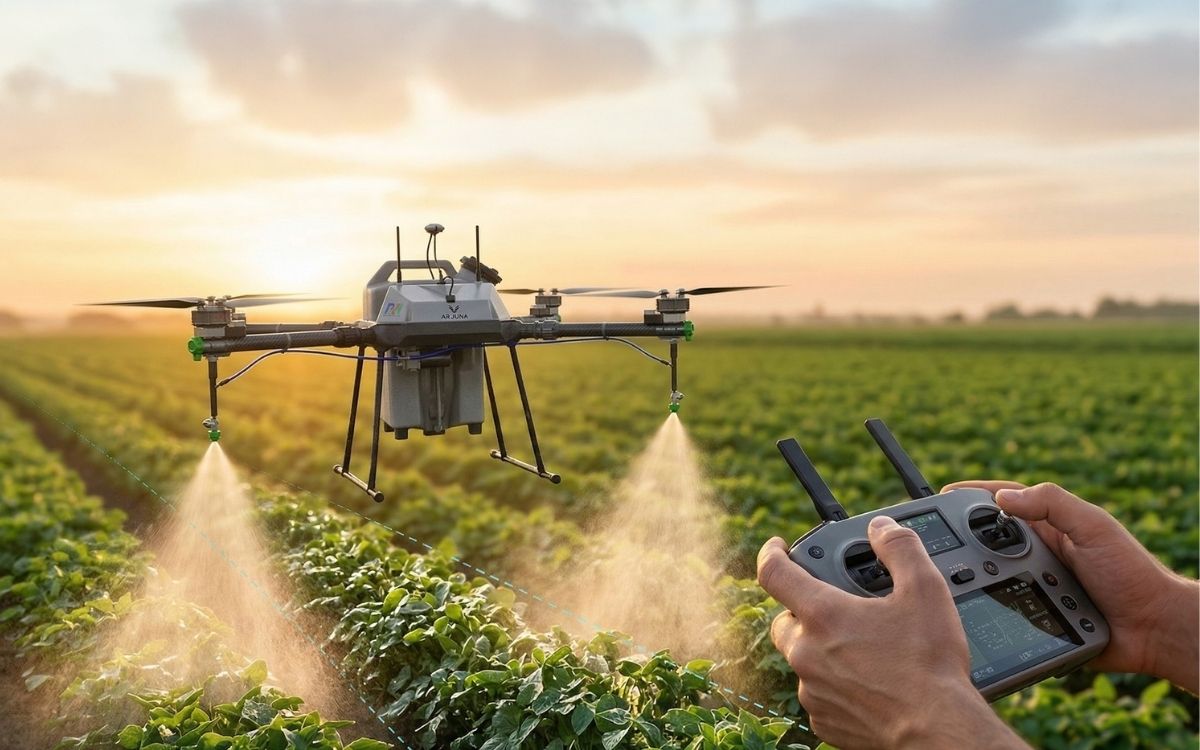
Drones increase coverage speed, ensure uniform application, reduce the physical burden on farmers compared to manual spraying, and meaningfully lower chemical exposure. A well-managed drone team can cover 25 to 30 acres per day — far beyond what conventional methods can achieve at comparable cost.
But drones alone do not create scale. They need to operate within a framework of trained pilots, compliance tracking, route optimisation, and service performance reporting to deliver repeatable results.
At Salam Kisan, drone technology is integrated into an end-to-end operating system — connecting factory production capacity, pilot training, and service coordination. This systems approach is what turns drones from a demonstration technology into a scalable service.
How Drone Service Works on the Ground
A structured drone service operation typically follows a defined workflow. Clusters are identified based on crop concentration and seasonal demand patterns. Bookings are managed through local advisors or service centres, and jobs are routed geographically to maximise operational efficiency.
Certified pilots complete pre-flight safety checks and equipment calibration before every deployment. Service data — including area covered, time taken, and volumes used — is recorded digitally during the operation. Completion reports are submitted to the central system for monitoring, analysis, and follow-up planning.
This disciplined operating model is what keeps service teams productive, pilots accountable, and compliance intact as the network grows.
Connecting Field Services with the Agri Marketplace
A field service network becomes significantly more powerful when it is integrated with input supply and advisory services.
If a pest problem is identified during a drone spray visit, the farmer should not have to wait days to access the right product. Connecting service delivery to the agricultural marketplace — as Salam Kisan is building with its integrated platform — means the farmer gets both the intervention and the inputs in a single, seamless experience.
This integration reduces friction, accelerates outcomes, and strengthens the relationship between the farmer and the platform. It also creates better demand data for inventory planning across the supply chain.
Key Metrics to Measure Field Service Network Success
Scalability must be measured, not assumed. The metrics that matter include acres serviced per cluster per month, operator productivity and asset utilisation rates, average turnaround time from booking to service completion, and repeat service rates by farmer and by crop type.
Financial metrics are equally important: cost per acre, revenue per cluster, and contribution margin at the cluster level. A network that grows without improving its unit economics is not truly scaling — it is expanding its exposure.
Tracking these indicators regularly ensures that growth decisions are grounded in evidence.
Common Challenges in Scaling Agri Field Service Networks
Scaling agricultural services comes with real constraints. Landholdings in India are fragmented, making route optimisation more complex. Demand spikes seasonally and is sensitive to weather. Drone operations carry additional regulatory requirements that must be actively managed.
Operator retention is a persistent challenge, as is maintaining consistent training standards across a geographically distributed team. Price sensitivity among farmers means that operational efficiency directly determines whether the model remains viable.
None of these challenges are insurmountable. But they cannot be solved reactively. They require systems designed to anticipate variability and absorb it — not react to it after the fact.
Best Practices for Building a Sustainable, Scalable Model
Expand in depth before expanding in breadth. Build strong clusters before spreading thin across new geographies. Standardise every process before increasing volume through it — scale amplifies whatever is already in the system, good or bad.
Invest in training infrastructure early, before it feels urgent. Use digital tools from the start, even if the volume does not yet seem to justify them. Set incentives across the network that reward performance and outcomes, not just activity. And track unit economics at the cluster level, consistently — because the health of the smallest unit determines the health of the whole.
Conclusion – Advisory, Drone Services, and Digital Infrastructure, Together
The future of agricultural service delivery is not about any single technology or tool in isolation. It is about building networks capable of delivering consistent, high-quality outcomes across different regions, different crops, and different seasons — reliably and at scale.
Advisory provides direction. Drone services provide speed and precision in execution. Digital systems provide coordination, transparency, and the intelligence to keep improving.
At Salam Kisan, this is the model we are building: an integrated, systems-driven approach to field service delivery that is designed not just to work today, but to grow stronger with every acre, every cluster, and every farmer we serve.